BF Innervation of the Amygdala
Monday, January 13, 2025
We have published our long-term study on ventral pallidum-amygdala innervation in collaboration with Dr. Nair’s Neural Engineering Laboratory at the University of Missouri. By combining anatomical and computational approaches, we explored whether basal forebrain (BF) projections to the amygdaloid complex modulate local network activity in a manner analogous to the well-characterized septo-hippocampal pathway.
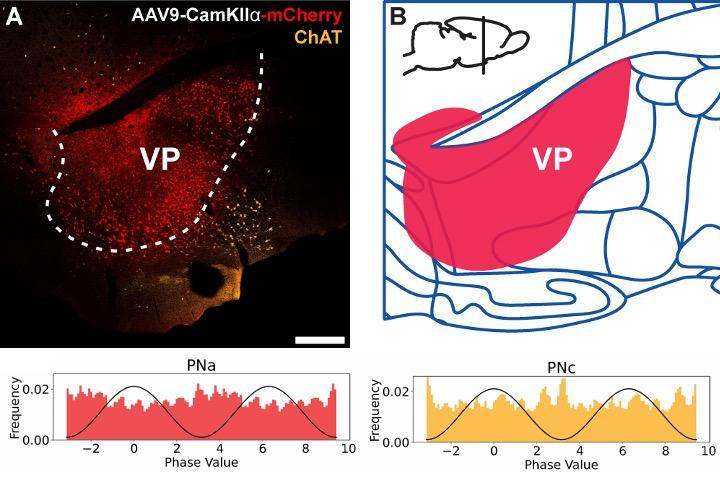
Our findings reveal a dense, non-cholinergic, and putative GABAergic projection from the ventral pallidum (VP) and substantia innominata (SI) to the basolateral amygdala (BLA). These VP/SI axonal projections to the BLA were confirmed using viral anterograde tracing and transsynaptic labeling techniques. To investigate the potential function of this VP/SI-BLA pathway, we employed a 1000-cell biophysically realistic network model, incorporating principal neurons and three major types of interneurons in the BLA, along with extrinsic glutamatergic, cholinergic, and VP/SI GABAergic inputs. In silico, we observed that theta-modulation of VP/SI GABAergic projections enhanced theta oscillations in the BLA, specifically through selective innervation of parvalbumin-expressing local interneurons.
These results suggest that long-range BF GABAergic projections may modulate network activity in their target regions through a shared interneuron-type and oscillatory phase-specific disinhibitory motif. Click here to access our paper.